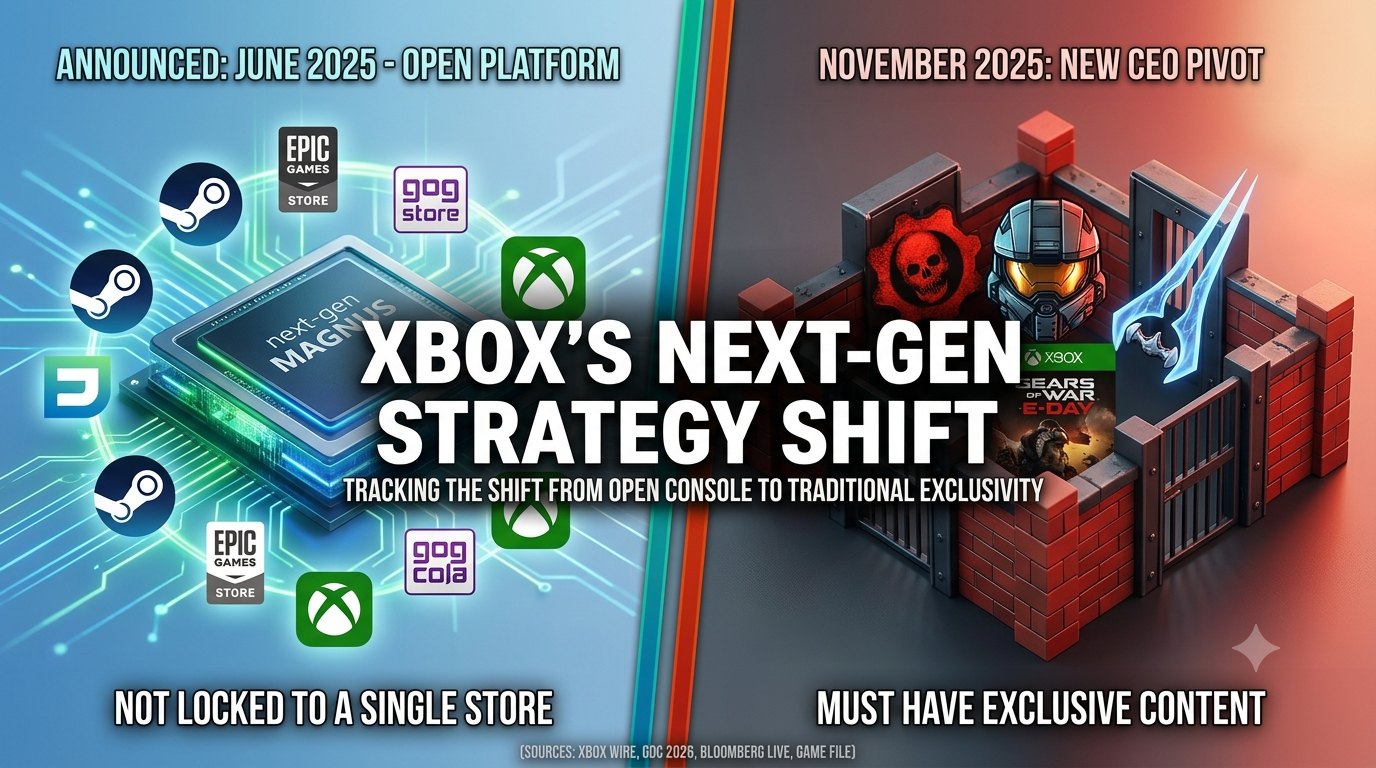
Back in June 2025, when Xbox first announced the AMD partnership that would become the MAGNUS chip, Microsoft told us the resulting hardware would deliver an Xbox experience "not locked to a single store or tied to one device". Five months later, the CEO who now runs Xbox has said, on the record, three separate times, that platforms need exclusive content to succeed.
Those two positions aren't the same strategy wearing different marketing copy. They're a contradiction, and nobody at Xbox has bothered to reconcile it.
What Was Actually Promised
When Project Helix was unveiled on Xbox Wire in March, the framing was unambiguous: an Xbox built to run your Xbox library and your PC library, without being locked to Microsoft's own storefront. Jason Ronald reinforced the hardware side of that pitch at GDC 2026, describing a custom AMD chip built for a machine that boots into a console experience but can also run a full Windows desktop underneath it.
“Helix will run Steam” was never actually confirmed. Microsoft never named Steam, Epic, or GOG as retail day-one storefronts.
What it confirmed was PC game compatibility in general terms. Everything past that, which specific stores, on what terms, with what cut of revenue was always inference.
Still, the intent was clear enough that Epic's Steve Allison said in February, under the Xbox leadership in place before Sharma took over, that Epic expected to be on the next console's storefront from day one, assuming Microsoft's stance didn't change.
It changed.
The Walk-Back, in Three Parts
Part one: distancing. Asked directly about the Epic comment in an interview with Stephen Totilo's Game File, Sharma didn't confirm the plan; she disowned it. She said the storefront conversations Allison was referencing happened under the previous regime, one she wasn't part of, and that future decisions on the matter would be made by her team going forward. What she offered in its place was noticeably vaguer: a platform that's open for more people to build on and customize, not a commitment to specific third-party stores.
Part two: the pivot to exclusivity. At Bloomberg Live on June 4, Sharma's hundred-day mark as CEO, she was asked point blank about Xbox's exclusivity strategy. Her answer: Xbox is the number-two publisher in the world and needs its games reaching broad audiences, but "in order to become a platform, you must have exclusive content and services." She said Microsoft is looking at that "very closely" and evaluating it title by title.
A platform "not locked to a single store" and a platform that "must have exclusive content and services" are pulling in opposite directions. One is about removing walls. The other is about building them back.
Part three: a rollout plan. Five days later, per reporting from Tom Warren, Sharma reportedly tied the exclusivity strategy directly to Xbox's financial health, describing a plan to start with one or two signature exclusives and expand from there as the business improves. That's the most concrete version of the pivot yet: not "we're thinking about it," but a stated sequence.
Three public statements, three months, one consistent direction, moving away from the openness Helix was sold on in March.
The Bottom Line
Project Helix's open-platform promise came from a leadership era that no longer runs Xbox. Its replacement CEO has spent her first hundred days publicly reintroducing the language of exclusivity, not once, but in escalating specificity, ending with an actual sequencing plan. The MAGNUS silicon underneath all of it doesn't force Microsoft's hand either way. It's a performance play that happens to keep the storefront door unlocked, whether or not Xbox decides to walk through it.
Until Microsoft names an actual storefront policy, not vague language about openness, not a hardware capability, but a stated list of what will and won't run on retail Helix hardware, everything else is a leadership team talking around a decision it hasn't made yet. I'd treat any headline claiming otherwise, in either direction, with the same skepticism I'd apply to any pre-launch console rumor: until it comes from Xbox directly, it's not confirmed.
Sources: Xbox Wire, Jason Ronald's GDC 2026 keynote, Asha Sharma's June 4 Bloomberg Live appearance, and subsequent reporting from Tom Warren.

0 Comments