
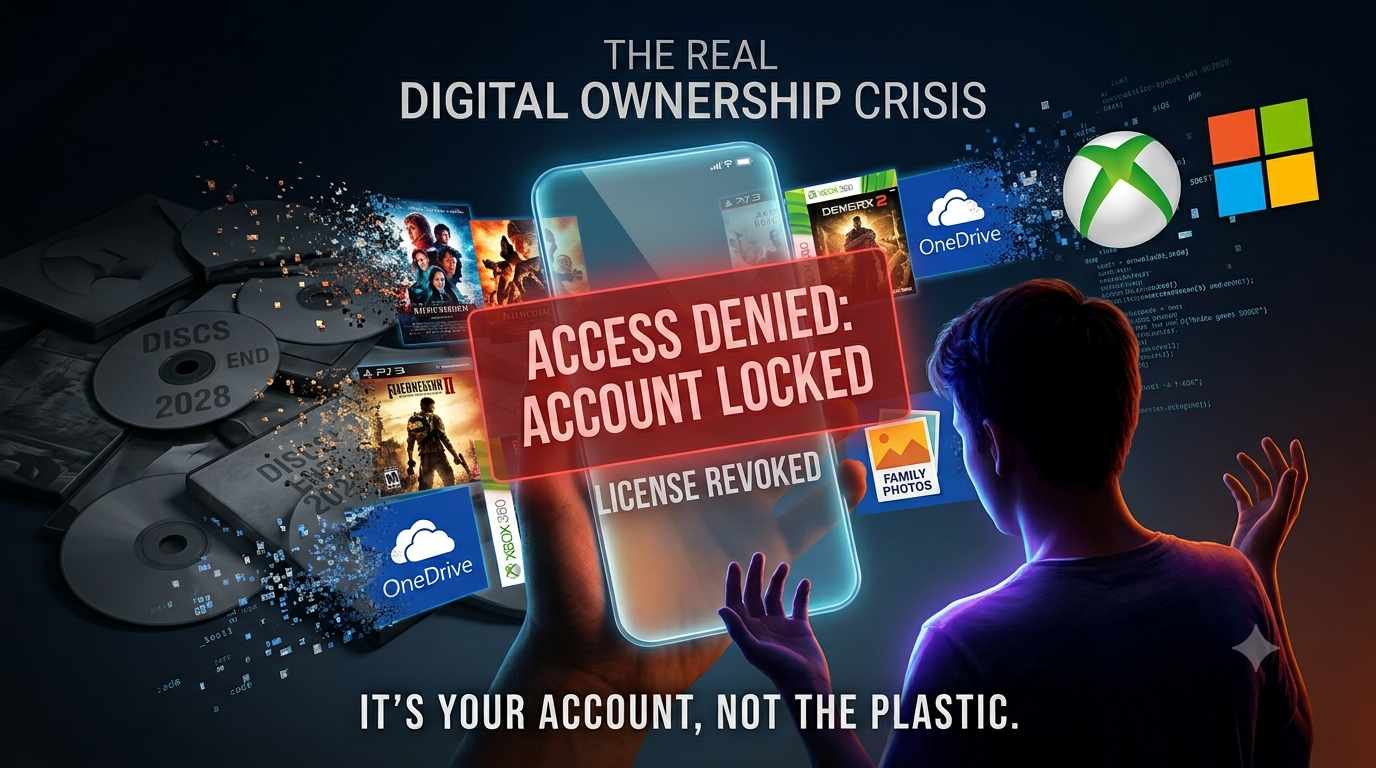
Forget the Discs — The Real Digital Ownership Crisis Is Your Account
Sony confirmed this month that physical disc production for new PlayStation games will end in January 2028. The internet responded the way it always does: nostalgia threads, "physical media is dead" hot takes, and a fresh round of arguments about collectors versus convenience.
That reaction is missing the point entirely.
Discs were never really the thing worth protecting. What a disc gave you was a physical, transferable, company-independent copy of a game that worked regardless of what happened to a corporate server somewhere. The disappearance of that format isn't really a story about plastic — it's a story about what's left once the plastic is gone: a license, sitting inside an account, that a single company controls end to end. And this month gave us a brutal real-world demonstration of exactly how fragile that arrangement can be.
The Sony announcement, in plain terms
Sony's blog post is short and doesn't dress up the reasoning: physical disc production for new games ends in January 2028, driven by "shifting trends in consumer preference" toward digital. Games already released or releasing before that date on disc aren't affected, this only applies going forward. Retail copies of new titles won't disappear overnight, but the pipeline that makes new discs stops.
Sony paired that news with a second announcement the same day: the PlayStation Store on PS3 and PS Vita is closing. Mexico, Honduras, and Nicaragua lose the ability to buy PS3 content starting August 2026, more Latin American and Middle Eastern countries follow later in 2026, and the rest of the world loses purchasing ability in July 2027. Sony says previously purchased content will remain downloadable "for the foreseeable future". That is language that should catch your attention, because "foreseeable future" is not a commitment, it's a placeholder.
This is the part that actually matters for the disc conversation. We've already run this experiment. Xbox shut down new purchases on the Xbox 360 Marketplace back in July 2024. Microsoft was clear at the time that owned content would remain playable and redownloadable, and by most accounts that has held up. But note the mechanism: your access to something you paid for now depends entirely on a company's ongoing willingness and technical ability to keep a redownload server alive. There's no disc in a drawer as a backstop. When Sony shuts down PS3/Vita purchasing, and eventually redownloads, whatever you bought there either survives because Sony chooses to let it, or it doesn't.
Then this happened
While the disc story was still generating headlines, a much scarier one broke, one that cuts straight to the real vulnerability. Twitch streamer Joshua Khane says his Microsoft account was hacked, and that Microsoft's response, after acknowledging he was the legitimate owner, was to permanently delete the account rather than restore it. Gone with it: 25 years of Xbox history, thousands of euros in digital game purchases, his Outlook email, and OneDrive storage that included family photos, including baby pictures of his son.
Khane did everything right by most accounts. He proved ownership, he got Microsoft to confirm the compromise and it still wasn't enough. That's not a disc problem. That's the whole model.
Khane shared what appears to be Microsoft's own explanation by email: the company said it had permanently suspended the account, calling the action irreversible and describing it as necessary to protect his data going forward. Multiple outlets reviewing the case note that once every piece of security information on an account has been changed by an attacker, as apparently happened here, Microsoft's standard recovery path essentially treats the account as unrecoverable, and a safeguard meant to be temporary quietly becomes permanent.
This isn't an isolated data point. It landed just a day after reports resurfaced of a Brazilian Xbox user who had to sue Microsoft to get a similarly locked account restored. Outlets covering the Khane story explicitly frame it against that earlier case as part of a pattern, not a one-off. And in the wake of Khane's post going public, other users came forward describing near-identical situations — accounts compromised, then quietly lost, with support routed through community volunteers rather than an actual internal recovery team.
Why this is the real story
Put these two stories side by side and the actual issue comes into focus. It was never really about whether you hold a piece of plastic. It's about what a single company's account infrastructure can take from you in one motion, with no external, redundant record of what you owned:
- A gaming library built over decades, gone if a storefront closes and the company eventually decides "foreseeable future" has expired.
- A gaming library also gone instantly if your account gets compromised and the recovery process fails, even after the company confirms you're the rightful owner.
- And because Microsoft in particular bundles Xbox, Outlook, OneDrive, and increasingly your Microsoft 365 documents under one login, a single compromised password can cost you your games, your email history, your cloud-backed photos, and your work files in the same stroke. Sony's ecosystem is narrower today, but PSN accounts are moving the same direction, more tied to your wallet, your friends list, and increasingly cross-platform services.
Digital licenses were built on the assumption that the platform holder would always be a reliable custodian of your stuff. Khane's case is the clearest evidence yet that assumption doesn't hold.
None of this requires a company to act maliciously. It just requires an account-recovery process that isn't built for edge cases, paired with a business model where "ownership" was always a license, not a deed. Discs at least forced a company to hand you something they couldn't take back. Digital licenses were built on the assumption that the platform holder would always be a reliable custodian of your stuff. Khane's case is the clearest evidence yet that assumption doesn't hold.
What should actually change
If the industry wants to survive the transition to all-digital without a steady drip of stories like Khane's, a few things need to happen that aren't currently guaranteed anywhere:
- A genuine account-recovery process for confirmed, verified owners — not a binary between "full restoration" and "permanent deletion," especially once a company has already acknowledged you're the real owner.
- Some form of downloadable proof of purchase or license record independent of the live storefront, so a closed store isn't the only record that a game was ever yours.
- Clear, published end-of-life commitments for storefronts - not "for the foreseeable future," but an actual date, the way Sony at least attempted with the PS3/Vita closure timeline.
- Separation of consequence - a hacked gaming account shouldn't be able to take your family photos and tax documents down with it, and vice versa.
Until one of these platform holders builds that, "digital ownership" is really just "conditional access," and the condition is: nothing goes wrong, forever. Khane did everything right by most accounts. He proved ownership, he got Microsoft to confirm the compromise and it still wasn't enough. That's not a disc problem. That's the whole model.

0 Comments